Offset Printing
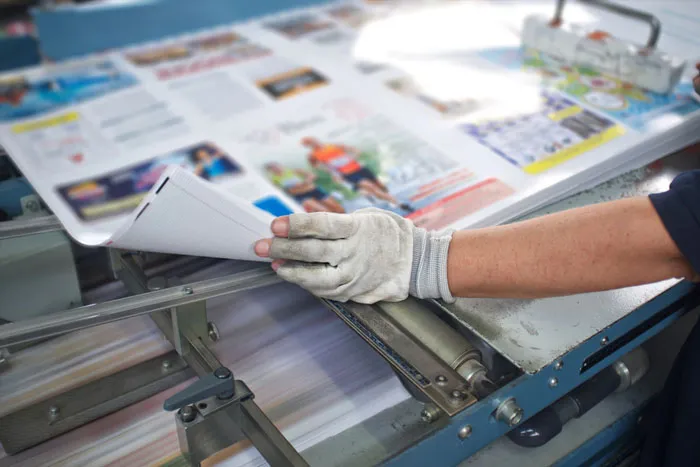
Offset printing is a printing technique widely used for high-volume print runs. In this method, ink is transferred to the printing surface via a rubber blanket cylinder.
What Is Offset Printing?
- Preparation: The design is prepared for print as a digital file or on film. This step includes colour separation, exposure and film preparation.
- Plate Making: The printing plate is what carries the image to the printing surface. Plates are usually made of aluminium or polymer-coated metal. Using a chemical process or laser technology, the plate is turned into a printing plate carrying the design.
- Ink and Water Balance: The balance between ink and water is critical. The printing cylinder has hydrophilic (water-attracting) and hydrophobic (water-repelling) areas that accept ink and water. Ink stays on the image areas, while water stays on the non-image areas. This balance is essential for high-quality results.
- The Printing Process: The ink roller comes into contact with the design on the printing plate. The ink is transferred onto the design on the plate and then passed to the printing surface via the rubber blanket on the cylinder. This happens at high speed and with great precision.
- Drying: The ink transferred to the printing surface then goes through a drying process. This dries the ink quickly and reduces the risk of smudging or running.
Offset printing is widely used to produce items needed in large quantities, such as books, magazines, brochures, catalogues, newspapers, posters and packaging. Because it delivers high-quality, economical prints, it has become a popular choice for industrial printing needs.
The Difference Between Offset and Digital Printing
Offset printing and digital printing are different techniques with some important differences. Here are the main points that set them apart:
- Printing Process: Offset is an industrial process involving a series of physical steps. The design has to be transferred to a printing plate, and the ink then passes from the plate to the printing surface via a rubber blanket. Digital printing is a more automated process: the design is created on a computer and sent directly to the printer.
- Print Volume: Offset is ideal for large print runs. Preparing and setting up the plates takes time, so it can be expensive for short runs. Digital printing is better suited to small and medium-sized jobs. Each job can be run independently and produced more flexibly and quickly.
- Colour Accuracy and Adjustments: Offset allows more precise control over colour accuracy. Colours can be reproduced more consistently using a predefined colour system and ink mixes. In digital printing, colours are usually sent straight from the digital file and can be adjusted more quickly. However, differences between print materials and machines can make colour matching more challenging.
- Print Materials: Offset can be used on various materials but is mainly used on paper and card. Digital printing works on a wider range of materials, including paper, card, plastic, metal, ceramics, textiles and many other surfaces.
- Cost: Offset can be cost-effective for large print runs. For small quantities, however, it can be expensive because of set-up costs and preparation time. Digital printing can be more economical for small and medium-sized jobs.
Examples of Offset Printing
Offset printing is used to produce many different products, so there is a wide range of examples.
Here are some common examples:
- Books: Novels, textbooks, guides and handbooks are printed in large quantities using offset. It is ideal for producing high-quality, durable books.
- Magazines and Newspapers: Regularly published magazines and newspapers are printed using offset. It is widely chosen because it can print large quantities at high speed.
- Brochures and Catalogues: Companies use offset-printed brochures and catalogues to promote their products and services. These can be printed to a high standard with rich colours, sharp text and detailed graphics.
- Posters and Billboards: Large posters, billboards and outdoor advertising can be produced with offset. It makes it possible to print high-resolution images at large sizes.
- Business Cards and Flyers: Offset is often used to produce professional business cards and flyers. These need to be high-quality, sharp and colourful, and offset meets those requirements.
- Packaging: Labels and packaging for food, cosmetics, medicines and other products can be printed using offset. Packaging needs to look attractive and professional, and offset can meet those requirements.
Because offset is used to produce such a wide range of products, the examples above are only a representative selection.
Ask for a free site survey.
We quote the same day based on sizes and photos.